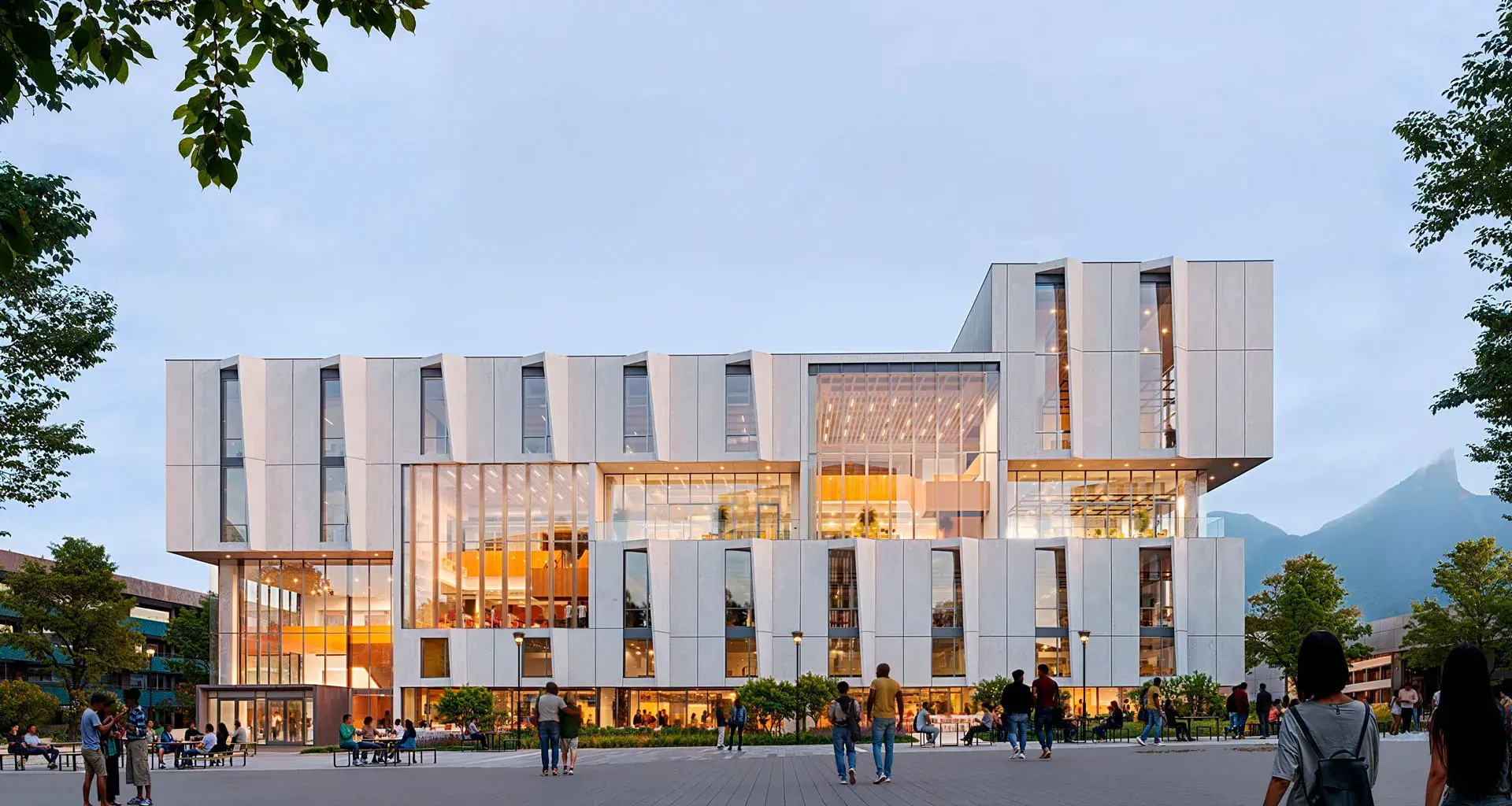

The Carlos Álvarez Design and Engineering Center, which will boost the Monterrey Innovation District, is scheduled to begin operations in early 2028.
Aimed at transforming ideas into tangible solutions, the Monterrey campus has presented the Carlos Álvarez Design and Engineering Center (CDI), a new academic hub that will form part of the Tec’s Innovation District.
This new space will serve as a strategic platform for students in the School of Engineering and Sciences, the School of Architecture, Art, and Design, and future interdisciplinary graduate programs.
“This building will have an academic purpose, to generate ideas and large-scale projects.
“Once these projects are developed, they can be scaled up to new stages and levels through EXPEDITION FEMSA and the Innovation Hub,” said Mario Adrián Flores Castro, Vice President of the Monterrey Region and General Director of the Monterrey Campus.
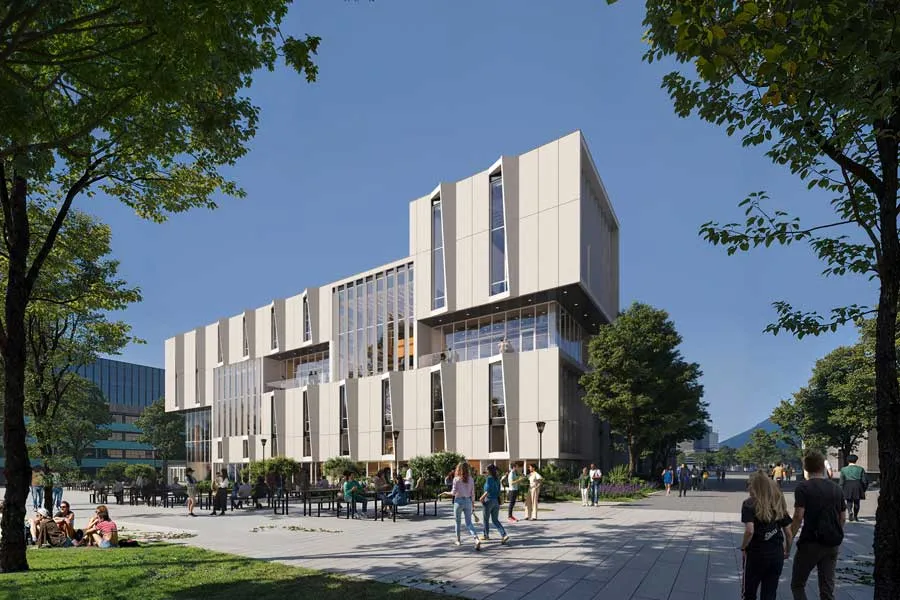
Construction began in January of this year, and the facility is expected to become operational in early 2028.
Flores Castro pointed out that the Carlos Álvarez Design and Engineering Center will include spaces designed to foster multidisciplinary collaboration and facilitate the transformation of ideas into products or services.
“Our goal is for the ideas that emerge from this center to be scientific and technological in nature and to focus on solving humanity’s problems, from Mexico to the rest of the world,” he said.
He added that the construction of this new facility reflects a commitment to environmental responsibility and the protection of the natural environment.
Ten of the thirty-five trees in the construction zone will be preserved, and six will be relocated within the site to become part of the CDI’s landscaping.
Also, nine trees will be relocated within the campus and ten will be removed, in accordance with the results of a specialized technical study; once the work is completed, eleven new trees will be planted.
“This new center will open up enormous opportunities for cooperation and collaboration.” - Gerardo Muñiz
Connecting multidisciplinary spaces
Located between the Convention Center and Classroom Building 3 on the Monterrey campus, the building will have four floors and 8,400 square meters of collaborative spaces with capacity for thirty students.
In addition to the specialized areas for design and prototyping, the central laboratories will form the heart of the building, featuring double-height spaces and cascading layouts.
There will also be common areas that connect shared facilities throughout the building.
“The building is designed so that ideas take shape on the fourth floor, in the laboratories, and then make their way down to the first floor, where they become a reality.
“The machinery that will power each of the prototype components in this multigenerational interaction will be located on the ground floor of the building,” said Mark W. Wood, Regional Dean of the School of Engineering and Sciences.
“Our goal is for the ideas that emerge from this center to be scientific and technological in nature.” - Mario Adrián Flores Castro
Promoting academic skills
Mark W. Wood said this new space will improve the implementation of the Educational Model by ensuring that Training Units fully address challenges.
“The challenge-based approach involves a wide range of stakeholders and educational partners, allowing us to work on much more complex projects right from the start of students’ academic journey,” he added.
The Carlos Álvarez Design and Engineering Center focuses on three main areas:
- Shaping the future: to propose innovative, sustainable, and revolutionary concepts in design and performance.
- Implementing changes: to develop and test prototypes to optimize their design, performance, manufacturing, and maintenance to minimize environmental impact.
- Capitalizing on social changes in a sustainable way: to provide society with smart and sustainable products, processes, and services.
“Thanks to the culture of collaboration between the two schools, these challenges will be resolved within three or four course units.
“This will allow for greater problem-solving and greater involvement from the design phase through to implementation via engineering,” said Alfredo Galván, Division Director of the School of Engineering and Sciences.
Inspiring the Tec community
Gerardo Muñiz, Director of the Regional Design Department at the School of Architecture, Art, and Design, said that this new center will create a vibrant experience for students and professors.
“This new center will open up enormous opportunities for cooperation and collaboration, especially when it comes to ensuring that projects can continue without interruption,” he said.
He added that the center will serve as a popular gathering place for the Tec community.
“We’re talking about interdisciplinary collaboration, so we hope that, in the future, this space will serve as a meeting place for students from all our schools,” he said.
READ MORE:
Seleccionar notas relacionadas automáticamente
1
Category:
Related stories