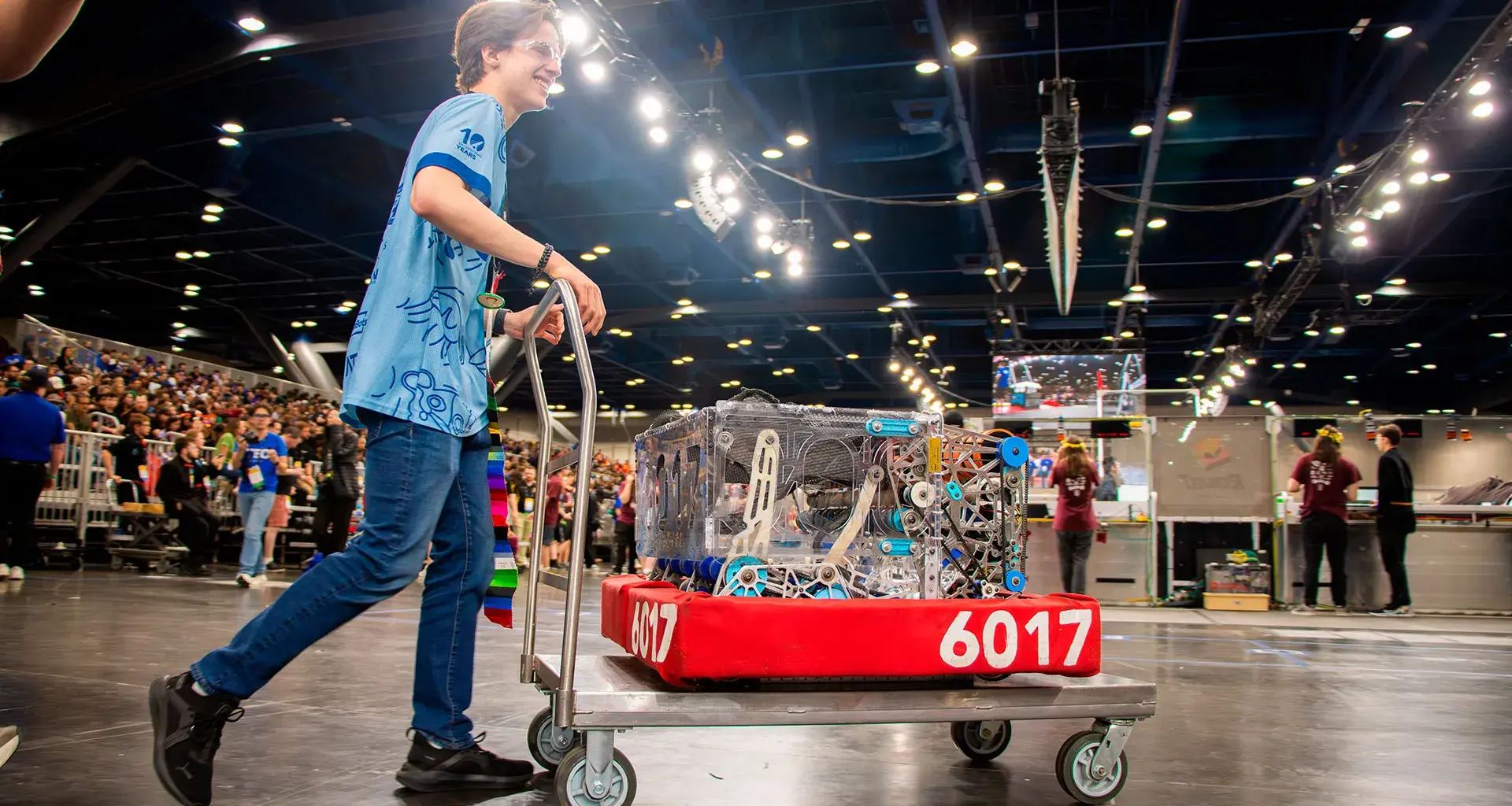

Cyberius, from PrepaTec, has reached the division finals at the 2026 FIRST Championship; the second Mexican team to reach that stage in this competition.
A Mexican team is once again among the best in the world in robotics, in Houston, Texas.
On the field, the score changed play-by-play. Cyberius 6017 held firm. It was a tie. They tried again.
The opportunity was there, but so was the difficulty: they were competing against some of the strongest robots in the competition.
This team from PrepaTec Santa Catarina campus has reached the division finals at the 2026 FIRST Championship, becoming the second Mexican team to reach that stage in this robotics championship.
“Mexican teams get here after winning regional competitions in the United States. We don’t just come to participate; we came to compete at the highest level”, said Francisco Guerra, National Robotics Leader at PrepaTec.

Cyberius and a historic milestone
In the qualifying phase, Cyberius secured six wins out of ten matches. This was enough to place them 20th out of 75 teams in the Daly subdivision and remain in contention.
Then came the playoffs, where they no longer competed alone. They formed an alliance with teams from the United States and Brazil —Eagle Force 2073, Under Control 1156, and Iron Claw 972—, in matches where each robot depends on the other.
Mexican team Cyberius has over 10 years of experience and has accumulated more than 15 awards throughout its history.
During the game, there were moments when the score was close and a comeback seemed possible. For a moment, the difference disappeared.
And even though they weren’t the division champions, the result marked a turning point for the team.
According to Pepe Santillán, the team’s mentor: “Cyberius had never played in the championship playoffs. This is a total triumph”.
“I’m more than happy with the performance. I couldn’t ask for more”.
Cyberius didn’t advance alone. LamBot, Botbusters, and Voltec also made it to the divisional playoffs, without reaching the final. This was Voltec’s first time.
“It’s really nice to see how more and more Mexican teams are managing to compete among the best in the world. This year, it was Cyberius and Voltec’s first time in the playoffs, and it’s really promising for other Mexican teams”.
These were the words of Daniela Guerrero, a former member of the Voltec team, who this year attended as a photographer on the StoryTeller program.

Mexico was indeed in the grand final, however not with a robot.
Although Mexico didn’t reach the championship final with a robot, it did feature in the most important playoff.
In the Einsteinplayoff, where the champions of each division compete for the world title, the voice of Mexican Samantha Muñoz was part of the decisive moment.
The Tec graduate participated as a Master of Ceremonies. Amid the stress of the championship final, her role is to lighten the tone.
Samantha takes the microphone, introduces the teams, and explains who they are and what each robot does.
“I’m the person who welcomes you to the playoff and introduces the world to each team and their robot”.
That moment also serves a crucial purpose: to channel nerves before competing. “We provide them with a moment of calm so they can breathe before the match.”
“The air is electric” is how she describes the energy of the place, where “the best of the best” compete.
This year, Samantha was accompanied by Mexican referee Alba Mendoza, a Tec graduate.
According to Francisco Guerra, “We have about 15 Mexicans volunteering in different roles at this championship, from referees and masters of ceremonies to general volunteers”.
These include Ricardo and Iván Delfín, Ana Ruíz, Lino Corlay, Fernando Tinoco, Leo Galván, and Karla Ruíz.

Mexico also excelled in innovation and teamwork
But Cyberius advancing wasn’t the only important moment for Mexico in the FIRST Championship.
Other teams also found their place beyond the competition, in the awards that value what goes on behind the scoreboard: the design, strategy, and teamwork.
- LamBot 3478, from San Luis Potosí, was awarded the Innovation in Control Award for its control system, a vital component in enhancing the robot’s performance during matches and precise real-time decision making.
- Voltec 6647, from Monterrey, was honored with the Team Spirit Award, for the team’s energy and ability to collaborate both on and off the field, an aspect that FIRST considers central to the competition experience.
“FIRST doesn’t just develop engineers; it develops young people who have learned to communicate, collaborate, and solve real-world problems. Here, they unlock skills and discover career paths that in many cases they never knew existed”, explained Francisco Guerra, National Robotics Leader at PrepaTec.
Unlike other technology tournaments, FIRST combines engineering, communication, leadership, design, project management, and multidisciplinary collaboration into a single competitive ecosystem.
In the pits, students specializing in mechanics, programming, electronics, graphic design, social impact, and outreach work together, understanding that the robot’s performance depends on the integrated coordination of all areas.

What is FIRST and what was the challenge?
The FIRST Championship is the world’s most important youth robotics tournament, where each season teams design and build a robot from scratch to solve a different challenge.
This year, from April 29 to May 2 in Houston, Texas, the challenge consisted of creating a machine capable of collecting balls, autonomously calculating distances, and shooting them accurately to score.
It’s a competition that simulates an archaeological zone under restoration: the robots are the builders and the balls represent the energy to work.
The first 20 seconds of each game are completely autonomous; then, for two minutes and 20 seconds, the robots are operated by students. Bonus points are also awarded for hanging from a three-level structure.
On this global stage, Mexico participated with 15 teams, 10 of which belong to PrepaTec, the leader of national representation at the competition.
- Cyberius 6017 (PrepaTec Santa Catarina)
- Lambot 3478 (PrepaTec San Luis Potosí)
- Botbusters 4635 (PrepaTec Eugenio Garza Sada)
- Roult 4403 (PrepaTec Laguna)
- Voltec 6647 (PrepaTec Eugenio Garza Lagüera)
- Overture 7421 (PrepaTec Cumbres)
- TecDroid 3354 (PrepaTec Querétaro)
- Lebotics 5948 (PrepaTec Cuernavaca)
- TecGear 6106 (PrepaTec Irapuato)
- XRams 6200 (PrepaTec Ciudad Juárez)

What’s more, the Tec had two further robots in the FIRST Tech Challenge (FTC), showcasing smaller robots: Hype Birds, from Mexico City; and Hornet from Overture, Monterrey.
In the 2026 FIRST Championship grand finale, the winning alliance was that of the Daly division, made up of the following teams:
- HighTide 4414 (Ventura, California)
- Madtown Robotics 1323 (Madera, California)
- Nerds of Prey 4065 (Florida)
- The Holy Cows 1538 (San Diego, California)
The championship was decided in a best-of-three series, in which the Daly alliance prevailed with two wins to one. In the final score, they totaled 712 points compared to the rival alliance’s 406.
According to Crisantos Martínez, National Dean of PrepaTec: “Participating in the Championship is an opportunity to showcase what our students are building on each campus and in each community”.
“Beyond the results, this experience reflects the commitment, creativity, and capacity for evolution they develop throughout the entire process”.
The championship also highlighted the competitive growth of Mexican teams within the global FIRST ecosystem.
Several teams reached the championship after winning regional tournaments in Mexico and the United States, facing particularly complex divisions this year due to the new international ranking system, where the 75 teams in each subdivision concentrate some of the top global talent.
Against this backdrop, FIRST organizers stressed that student robotics is no longer limited to building machines but is about developing young people who are capable of solving complex problems, collaborating under pressure, and evolving in the face of real-life high-level international competition.
DISCOVER THE JOURNEY OF THE PREPATEC TEAMS:
Seleccionar notas relacionadas automáticamente
1
Category:
Related stories