
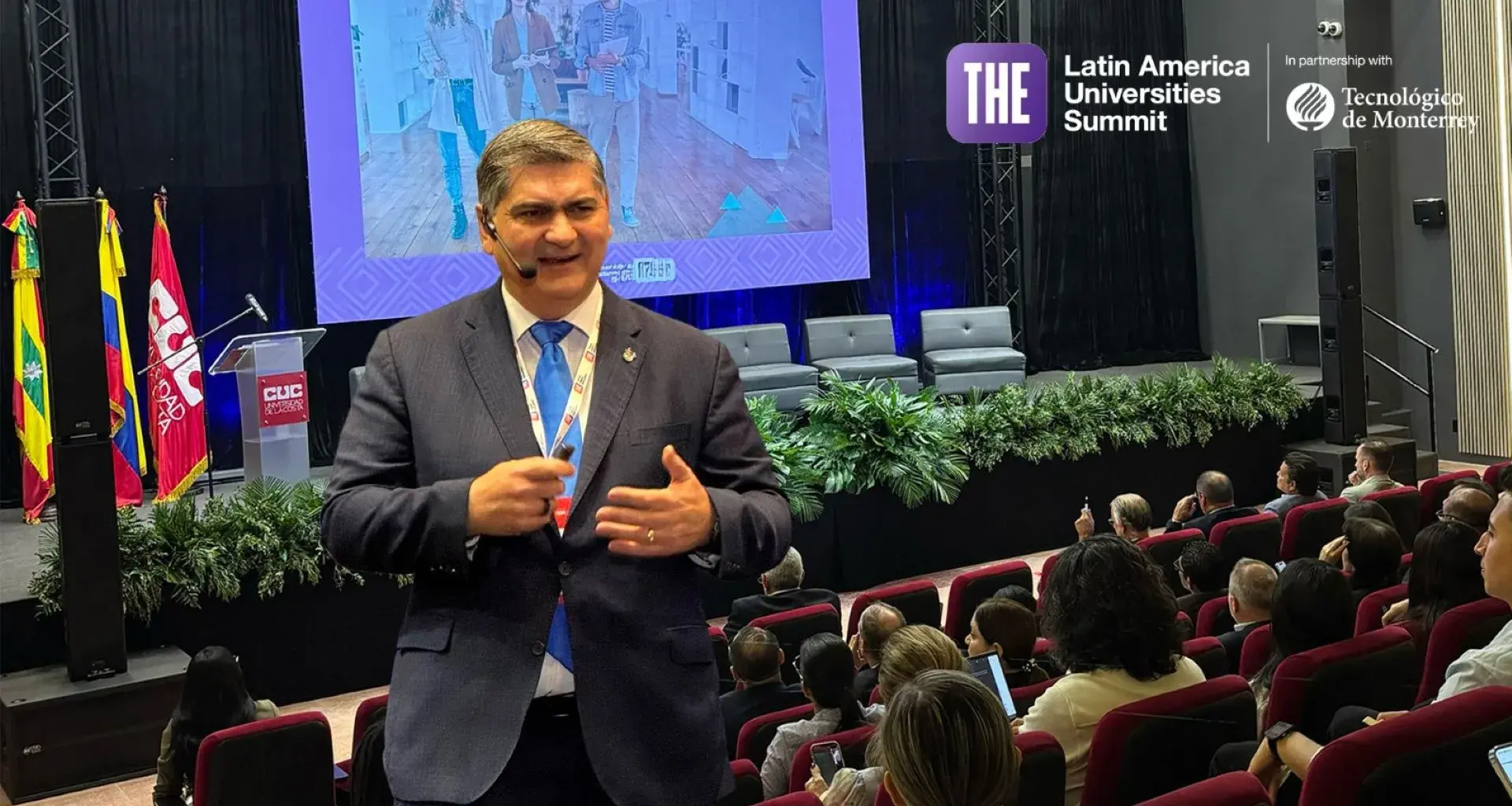

In Colombia, Garza spoke about the evolution of higher education in recent years at an event organized by Times Higher Education.
“We can’t allow ourselves the luxury of waiting 200 years for things to happen in our region.”
With this reflection, David Garza, Executive President of the Tecnológico de Monterrey Education Group, began his speech at THE Latin America Universities Summit 2026, an international forum that brought together education sector representatives and public policymakers.
During his speech, Ideas for the Future of Higher Education in Latin America, Garza spoke about the challenges and opportunities facing higher education in the region.
He said that these challenges are artificial intelligence (AI), lifelong learning, and contributing to productivity through innovation, business relations, and entrepreneurship.
The event, organized by Times Higher Education (THE), was held in Barranquilla, Colombia, from May 12 to 14, 2026, under the title of Advancing learning, innovation, and societal impact.

Challenges of higher education in Latin America
In his speech, Garza said that Latin America has made progress on life expectancy, access to education, and female participation in higher education.
However, he emphasized that it still faces important challenges in economic development, labor productivity, and equitable access to universities.
“As resilient institutions, we know that our countries need to further elevate coverage and access to universities,” he said.
He also said that the region is entrenched in a complex scenario marked by limited economic growth and stagnant labor productivity over recent decades.
What’s more, he mentioned that the higher education sector is facing greater criticism over the value of spending several years studying for a university degree, especially in an environment where the labor dynamics are changing quickly.
“This can’t be done with the traditional model we have today; it has to be another model, that of lifelong learning.” - David Garza
Artificial intelligence and new skills
One of the main topics addressed was the impact of artificial intelligence on the future of work and higher education.
The executive president of the Tecnológico de Monterrey Education Group explained that universities should prepare students for an environment in which people and algorithms coexist in decision-making processes.
“Now, we’re going to be managing people and algorithms that coexist in the decision-making process,” he said.
Moreover, he highlighted the importance of strengthening human-centric skills and opening spaces for discussion on the responsible use of artificial intelligence.
He also mentioned that although people tend to talk about the jobs that could disappear, we need to consider the new jobs and opportunities that emerge from these technologies.
Regarding the technological acceleration of artificial intelligence, Garza said that certain studies discuss how our region could leverage this to the benefit of productivity.
“There’s a lot of talk about the jobs that could disappear and not so much about the new jobs that will be created; several of our countries are already making progress in these areas of adopting artificial intelligence, as seen on the Latin American AI Index, which monitors how prepared we are in this area,” he said.
“We know that the models are advancing with increasing rapidity. Previously, they understood text and images. Now, they understand the physical and biological world. Soon, we’ll be entering an era of AI agents. Although companies are investing in artificial intelligence, they aren’t yet seeing the return on the investment that they’re making in these areas.”
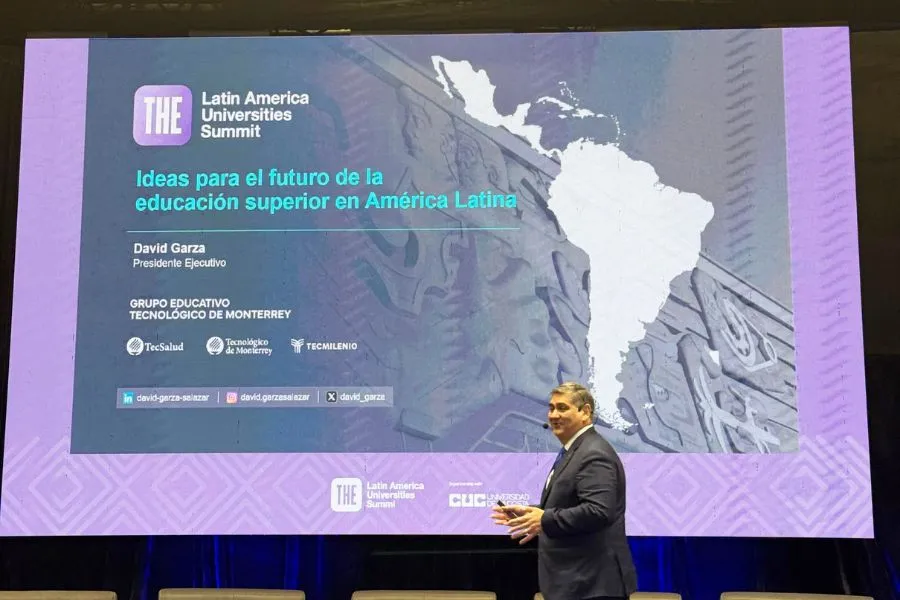
Lifelong learning
Another of the central messages of his talk was the need to evolve the traditional university model toward lifelong learning schemes.
He mentioned that universities should teach not only students on formal programs but also those people who are already working and need to acquire new skills.
“This can’t be done with the traditional model we have today; it has to be another model, that of lifelong learning,” he said.
By way of example, he shared that the Tecnológico de Monterrey Education Group currently teaches over 200,000 people on lifelong learning programs in on-site, hybrid, and on-line formats.
Innovation and entrepreneurship as regional opportunity
During his speech, Garza also talked about Latin America’s entrepreneurial potential and the importance of strengthening innovation ecosystems between universities, companies, and governments.
He explained how the combination of AI and entrepreneurship opens up new possibilities for creating more agile and accessible companies.
“We have the option of saying, ‘These challenges are so difficult that someone else should solve them,’ or deciding to do so for precisely that reason,” he said.
“The figures from Monterrey drew our attention; they’re not afraid of innovation or the advances of artificial intelligence.” - Eduardo Verano de la Rosa
Colombian governor highlights innovation in Monterrey
Garza shared the stage with leaders such as Julián Cristiá, Principal Economist at the Inter-American Development Bank (IDB); Eduardo Verano de la Rosa, Governor of Atlántico Department; and Raquel Bernal, Rector of Colombia’s University of the Andes, to name but a few.
During the event, the governor of Atlántico Department remarked on the opportunity he’d been given to travel to Monterrey and the impact the visit had made on him.
“We went there and they showed us around for four days. Although they gave us a tour of the companies, the most important thing was the company-university relationship.
“That relationship had produced some very important results, such as the fact that they’re not afraid of innovation or the advances of artificial intelligence, even though that requires discipline and order.”
The governor highlighted Monterrey’s close ties with Texas.
“They decided not to spread themselves all over the world but to concentrate on that large, consolidated market, which requires many services they can provide in Monterrey. The result of them making that decision was that it enabled them to grow.”
Verano de la Rosa singled out Monterrey as one of the most advanced cities in Mexico in terms of industry and innovation.
An urgent agenda for the region
According to UNESCO, although higher education enrollment has doubled over the past two decades in Latin America, there are still important gaps in terms of students completing their studies and equitable access.
In this vein, Garza Salazar discussed how universities can build more flexible, resilient, and inclusive systems, which are capable of broadening opportunities, incorporating innovation with social purpose, and responding to an increasingly dynamic environment.
To this end, he presented three ideas: AI as a great opportunity to transform higher education, fostering productivity, and preparing people for a world in which humans and algorithms coexist.
He said that universities should evolve their educational models, develop new skills, and aim for lifelong learning to retrain talent for technological changes.
At the same time, he remarked that it is essential to strengthen innovation and entrepreneurship ecosystems through partnerships between universities, government, and companies.

What is THE Latin America Universities Summit?
Times Higher Education (THE), a British magazine and agency based in London, is globally recognized for preparing one of the most influential and prestigious university rankings: the World University Rankings.
THE Latin America Universities Summit is an international event that brings together university leaders, political figures, and education sector representatives to discuss the future of higher education in Latin America.
Its 2026 edition was held at the University of the Coast in Barranquilla, Colombia, gathering over 250 attendees, 100 organizations and universities, and 50 international speakers.
The main topics addressed included artificial intelligence, digital transformation, interdisciplinary innovation, educational equity, and the strengthening of resilient, future-ready institutions.
Also taking part in the event was Neil Hernández-Gress, Director of Research at Tecnológico de Monterrey.
The Education Group, consisting of Tec de Monterrey, Tecmilenio, and TecSalud, took part in this summit under the institution’s Plan for 2030 vision, which seeks to strengthen its global positioning through international opportunities for collaboration.
YOU’LL SURELY ALSO WANT TO READ:
Seleccionar notas relacionadas automáticamente
1
Category:
Related stories