
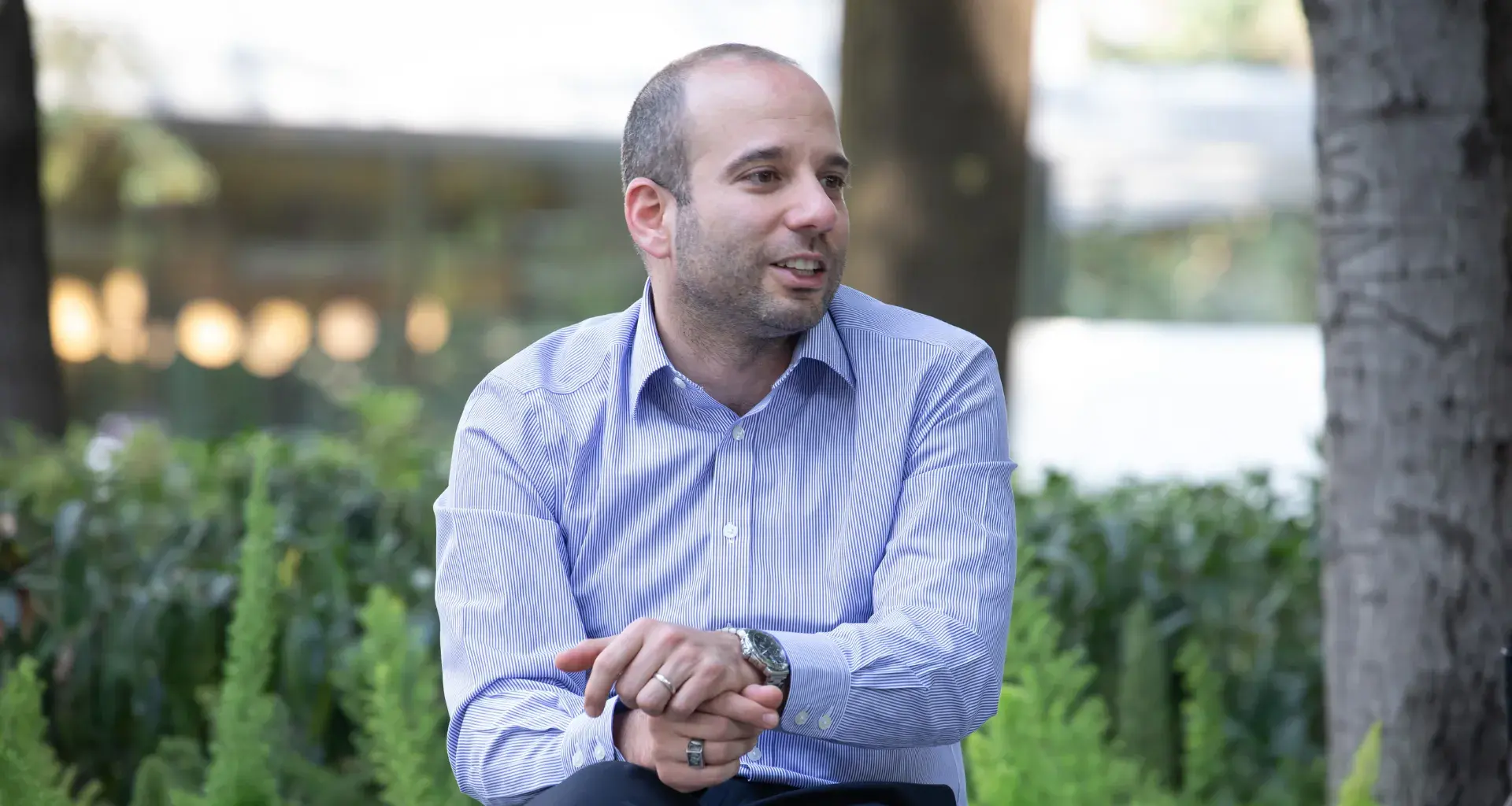

Miguel Modestino is a chemical engineer who seeks to answer the question: How can we maintain the economic and social prosperity that oil has made possible without destroying the environment?
“All Venezuelans have oil in their blood”, says Miguel Modestino, half jokingly.
He grew up surrounded by refineries, with towers and permanent flames coming from their tops. “Oil,” says the Venezuelan scholar, “has always been viewed as something positive.”
“It’s the heart of the country. It’s what drives the entire economy”. However, there was also another side to it.
“You have this contrast between this spectacular environment and this black thing that’s environmentally disastrous, but in terms of economic and social development, it’s a godsend. That contrast pretty much sums up the things I do”.
A distinguished visiting professor of industrial decarbonization at Tec de Monterrey and an associate professor at NYU, he has dedicated his career to addressing the key question: How can we maintain the economic and social prosperity that oil has made possible without destroying the environment?
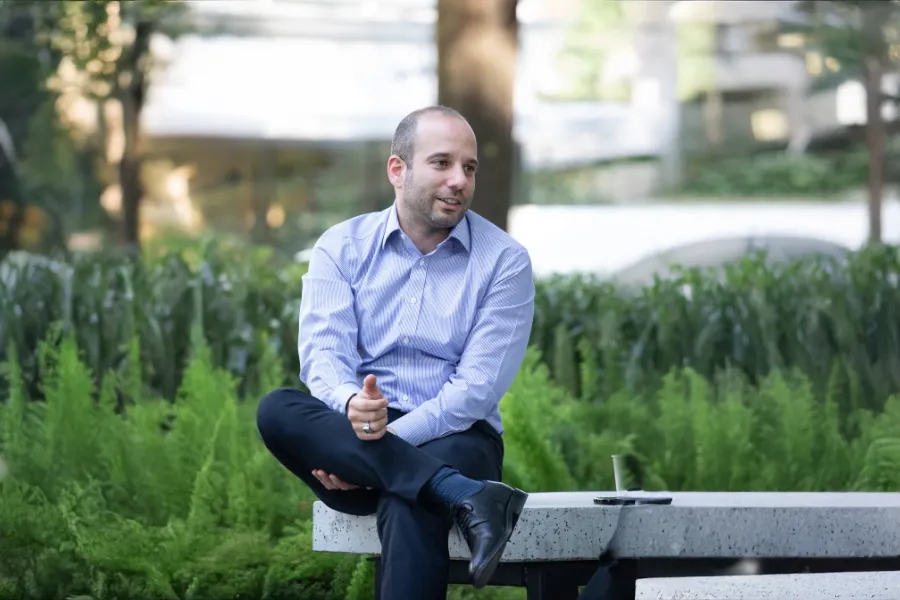
How can we use oil without destroying the environment?
Miguel grew up in Caracas, but his family is from Píritu, a small colonial town in eastern Venezuela.
“With crystal-clear waters and white sand stretching out from Isleta de Píritu, the scenery seems perfect. Until you open your eyes. Right across the street is the country’s largest refinery and petrochemical plant. You’re in paradise, but you see smoke billowing out, and you say, ‘This can’t be happening.’”
Since then, the question has lingered, reappearing time and again in his conversations.
“How can we maintain the economic and social prosperity that this resource has brought us without destroying the environment?”
There is no simple answer to that question. Miguel explains it this way:
“Today, more than 80%, perhaps even more than 90%, of oil is used to produce energy. However, that doesn’t have to be permanent. There are alternatives: solar, wind, nuclear, and hydroelectric power”.
He points out that in Venezuela electricity was generated primarily by hydroelectric power for years, even though it is an oil-producing country.
“All Venezuelans have oil in their blood” - Miguel Modestino
According to him, the real challenge is how to achieve energy transition without disrupting modern life.
This hydrocarbon is not just fuel. It is in clothes, in plastics, and in the materials that support our daily lives.
“We should stop using oil as fuel and focus on using it to create materials.”
Miguel isn’t suggesting we get rid of it all at once but rather that we rethink its use.
We need to integrate clean energy to produce the materials we use, reduce emissions, and design circular processes.
“We might even be able to outlast oil by a long shot,” imagining a future where it remains relevant but as a much smaller part of the picture, with a positive social impact and without the current environmental burden

The closest thing to magic there is
deeper to him.
“When I first started learning chemistry, I was fascinated by the fact that you can transform matter. It’s the closest thing to magic there is”.
You start with one thing and turn it into something else. You transform it. You alter reality at the molecular level. From there, engineering came almost naturally.
He studied chemical engineering and was just one class away from completing his degree in chemistry as well.
It was not just an interest in reactors, but in what was happening inside them, in the invisible reactions of the world.
“We should stop using oil as fuel and focus on using it to create materials"- Miguel Modestino
His academic studies took him to the United States. At the Massachusetts Institute of Technology (MIT), he found an environment where he could explore that interest through applied science.
That led to his doctoral degree, which focused on solar fuels.
“If oil is essentially solar energy that has been stored over millions of years, why not speed up that process? Why not capture the sun’s energy directly and turn it into fuel?”
That work laid the groundwork for what was to come. Working with his research team, he began to integrate clean energy with materials manufacturing, specifically polymers and plastics.
The challenge was enormous: the chemical industry produces around 70,000 different products. Every process has an environmental impact. Changing one reaction at a time seemed impossible, unless science itself could be sped up.

The only way to accelerate science: AI
Machine learning was introduced to his lab between 2018 and 2019.
“If we want to transform an industry that took 100 years to build in just 30, we need to step up the pace.”
Research could not continue in the same way. They started with simple models, trained using manually designed experiments. It worked.
Then came more experiments. Next, robots. Then automation. Laboratories become capable of running thousands of reactions in parallel, generating reliable data, and identifying patterns invisible to the human eye.
“Chemistry and AI are the closest thing to magic there is” - Miguel Modestino
“Chemistry is magic.” He compares it to artificial intelligence. The first time he saw a conversational model, he thought the same thing: “This is magic”.
However, it was a magic rooted in data, training, and accumulated knowledge.
In science, that level of data does not yet exist. To do this he aims to generate the data: millions of reactions, perfectly recorded, so that the models can learn how the chemical universe works.
That approach also led to Sunthetics, a startup that began by seeking to produce nylon, the world’s most widely used synthetic fiber, in a more sustainable way, and which eventually evolved into a software company specializing in the optimization of chemical processes through machine learning.

The Tec as a laboratory for the future
Today, Miguel moves between three fields: chemistry, engineering, and artificial intelligence. He is beginning to build a lab out of Mexico.
Tec de Monterrey, he says, is a unique platform. “If anyone is going to transform the way science and technology are developed in Latin America, it’s the Tec”.
His goal is to build the leading sustainable energy group in Latin America and establish it as a global benchmark. We should not simply copy European or American models but rather develop solutions that work in this context.
He also aims to build real research capabilities in the area of decarbonization.
Since joining the Tec, Miguel has worked with the energy team on four strategic fronts: sustainable transportation, industrial supply chains, solar thermal systems, and chemical energy conversion.
“In Latin America, the electrification of transportation is already underway, and the challenge isn’t only technical but also involves system design. This is where the Tec’s strengths in industrial engineering and operations research come into play, as they enable the analysis of regional supply chains with global implications”.
Examples include solar thermal systems, a key technology for generating heat in both buildings and industrial processes, and chemical engineering, where the fundamental energy conversion processes can be understood and optimized.
“Mexico also has a unique opportunity: biomass conversion, a way to produce energy and materials in ways that haven’t yet been fully explored”.
Miguel explains that it is essential to understand what energy transition means from a systems and public policy perspective and how it impacts communities, the economy, and the region.
With that in mind, early last year a team of researchers from New York University and the University of Chile was formed to develop decarbonization models which outline pathways that are economically viable, socially beneficial, and aligned with a shared vision for the future.
Another area he focuses on at the Tec is agriculture as a living laboratory.
“It’s possible to conduct cutting-edge research directly in the field: producing food, working with livestock, analyzing water resources, designing circularity models, and implementing technologies and data science, all at the same time”.
Miguel understands that the problem he is trying to solve is complex, but he also says, “We’ve never had so many tools at our disposal before.”

About Miguel Modestino
Miguel Modestino is a distinguished visiting professor of industrial decarbonization at Tecnológico de Monterrey’s School of Engineering and Sciences.
He is the Donald F. Othmer Associate Professor of Chemical Engineering at New York University (NYU) and Director of the NYU Sustainable Engineering Initiative, where he leads research focused on sustainable chemical processes.
Modestino is a co-founder of Sunthetics, an NYU spin-off company that develops machine learning-based optimization software for more sustainable chemical manufacturing processes.
That initiative was featured in the National Geographic documentary “Own the Room” for Disney+.
Modestino is a co-inventor on nine patent applications related to electrochemistry and machine learning, and has received funding from organizations such as NASA, the National Science Foundation (NSF), and ExxonMobil.
His academic output includes more than 65 publications in peer-reviewed scientific journals such as Energy & Environmental Science, PNAS, Nature, and Joule.
He has received numerous awards, including:
- Journal Futures Speaker 2022, presented by the American Institute of Chemical Engineers (AIChE)
- ACS Energy & Fuels Rising Star 2022
- Speaker at TED Countdown 2022
- Winner of TED Idea Search Latin America 2021
- Named an Innovator Under 35 by MIT Technology Review (Global 2020 and Latin America 2017)
- 2019 NSF CAREER Award at the start of his career
His appointment at the Tec is part of the institution’s strategy to attract and bring together global talent in key areas such as industrial decarbonization and sustainability within the School of Engineering and Sciences.
YOU MAY ALSO BE INTERESTED IN:
Seleccionar notas relacionadas automáticamente
1
Category:
Related stories