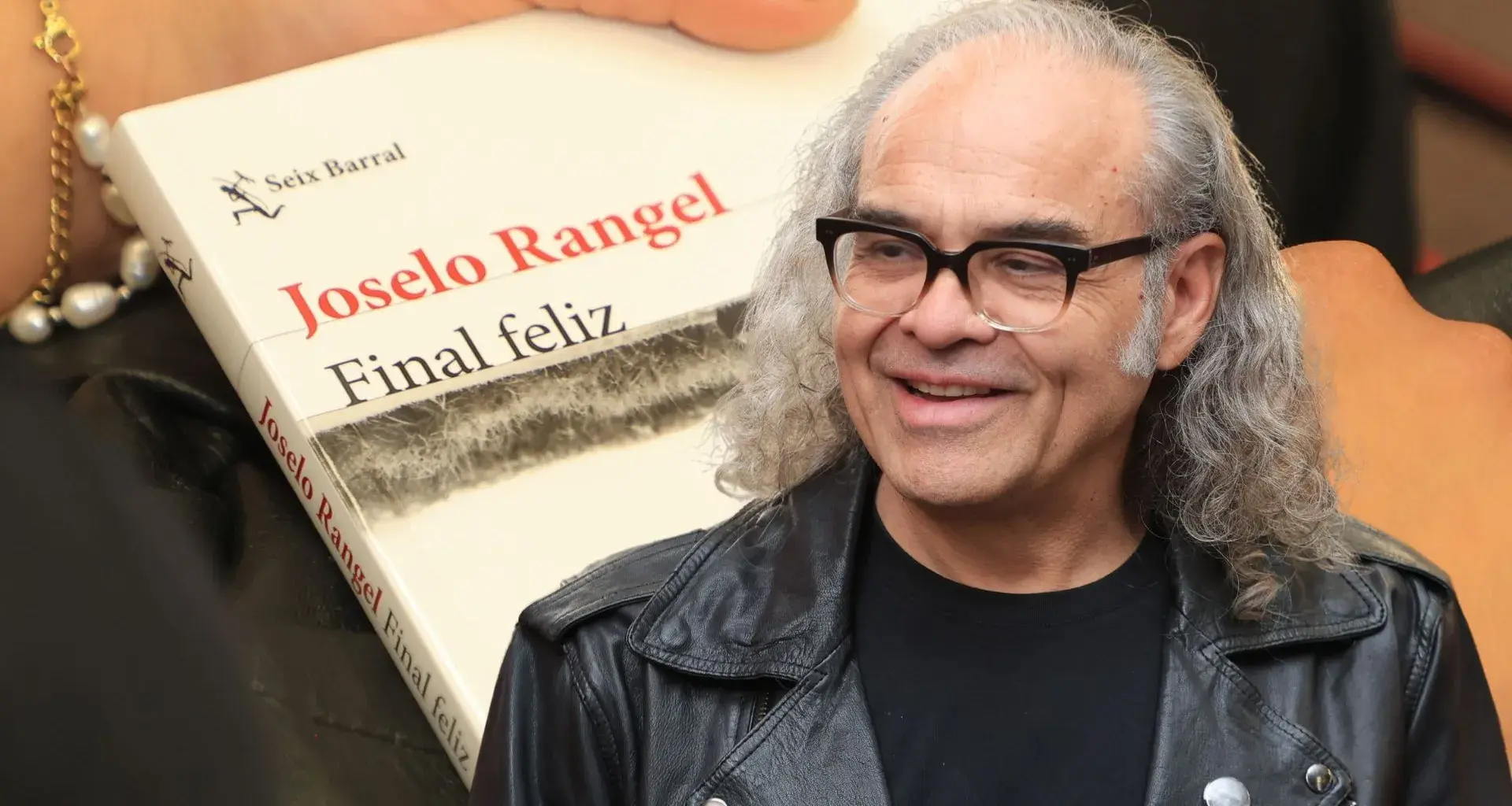

Joselo Rangel, a founding member of Café Tacvba, shared four insights on art, fiction, humor, and his relationship to the humanities.
Musician and writer Joselo Rangel, a founding member of the alternative rock band Café Tacvba, visited the Tec as part of Humanities Week held on its State of Mexico campus, where he presented his latest book: Final feliz (Happy Ending).
This collection brings together twelve short stories that explore themes such as love, memory, and goodbyes through a narrative which blends the ordinary with the extraordinary.
However, beyond the book launch, the event focused on creative processes, anecdotes, the role of art in everyday life, and the ways in which writing can challenge notions of masculinity, memory, and emotions.
“You don’t know what’s inside you, but art brings it to light. That’s what I love about being an artist,” Rangel said.

As part of his presentation, Joselo Rangel shared these four reflections on art, writing, and his relationship with the human condition:
1. Art as a subversive act
Rangel talked about art’s capacity to reveal unknown aspects of oneself.
The writer highlighted that while creativity involves both literary and personal risks, it is also a form of constant discovery.
He recalled that, after publishing one of his books, even his close friends and family were surprised by what they read, which made him realize how his own writings could reveal aspects of himself he hadn’t known until then.
“Art does something to us; you never know what will come out of you,” the artist said.
2. Humor as a response to life
According to the author, humor is not an end in itself, but a natural consequence of observing reality.
“It’s a response to the busy lives we lead. If I thought about wars all the time, I wouldn’t get out of bed. Art has saved me,” said the Café Tacvba member.
Through a narrative style in which humor arises almost by chance, Rangel said that laughter comes naturally, without aiming for it.
He added that although he doesn’t write with the intention of making people laugh, he ends up doing so as a natural consequence of the way he observes and recounts life.

3. Curiosity about the human condition
His stories begin with everyday situations—relationships, memories, or even chance encounters—and evolve into tales with unexpected twists, in which the fantastical and the philosophical emerge from the ordinary.
Rangel describes himself as a tireless observer—”a die-hard gossip,” he says—though he clarifies that what truly interests him is the human condition and understanding people’s emotions, struggles, and even contradictions.
He recalled how, even as a young man, he enjoyed listening to and imagining the stories of those around him, wondering, for example, “Why would a couple who seem so happy suddenly have such a heated argument?”—a curiosity that today serves as the starting point for his stories.
4. Discipline and craft in writing
According to Rangel, his experience writing columns for Excélsior was key to developing his perseverance. Over the years, he would send his manuscript punctually every Thursday at 2:00 p.m., a routine that he believes gave him structure and helped him hone his craft.
He compared writing to any activity that requires time and practice, from playing a musical instrument to playing video games. Over time, amid stories of the band’s travels, books, movies, and everyday life, he discovered something more personal: science fiction.
For a whole year, he wrote 52 short stories that he posted on a blog—a practice that, although not his original intention, he believes ultimately helped him develop his narrative voice and definitively steered him toward fiction.
In his book Final feliz, he offers us an intimate glimpse into everyday life, in which fiction becomes a means of exploring emotions, contradictions, and ways of understanding the human experience.

Throughout the last 17 years, The Tec’s Humanities Week on its State of Mexico campus has served as a forum for reflecting on the human condition through philosophy, literature, and the arts.
In this 2026 edition, the aim was to bring these topics closer to the community by focusing on everyday life and emotions. With that in mind, Joselo Rangel’s visit made the connection directly between writing and the cultural industries.
“That’s what I love about art: you don’t know what’s inside you, and art brings it out.” —Joselo Rangel.
“The institution reaffirms its commitment to serving as a gathering place where cultural expressions converge, voices engage in dialogue, and a humanistic education comes to life both inside and outside the classroom.”
“Joselo Rangel’s presence is significant because he embodies two pillars: symbolic expression through literature and the cultural industries,” concluded José Manuel Noriega, a professor in the Department of Humanities at the Tec’s State of Mexico campus.
Among its activities, Humanities Week featured workshops and educational sessions on topics such as neurodiversity, emotional wellbeing, crafts, creative writing, sustainable development, music, and poetry.
DON’T LEAVE WITHOUT READING:
Seleccionar notas relacionadas automáticamente
1
Category:
Related stories