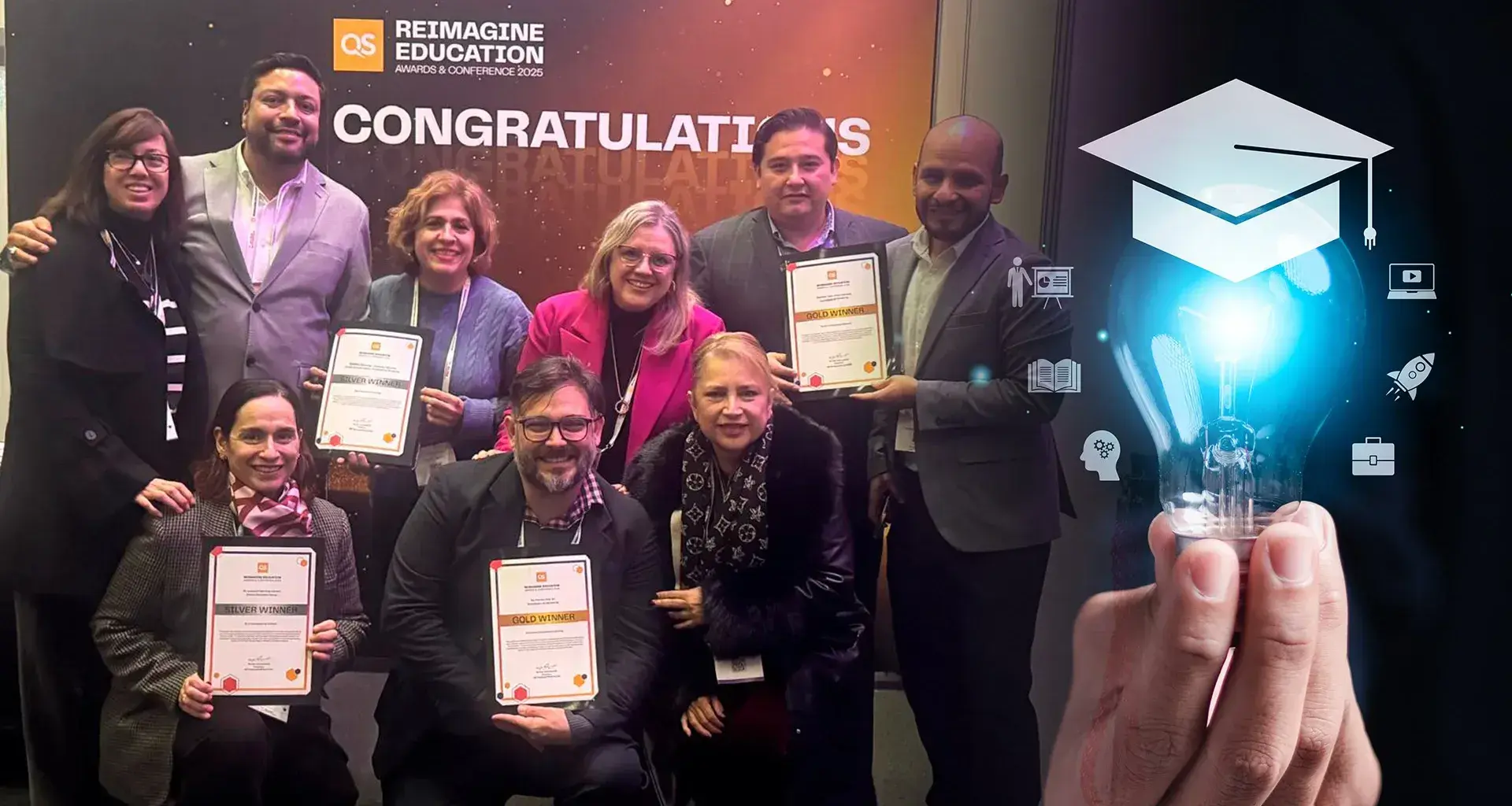

A total of thirteen Tec projects were finalists in the 2025 QS Reimagine Education Awards with four winning medals
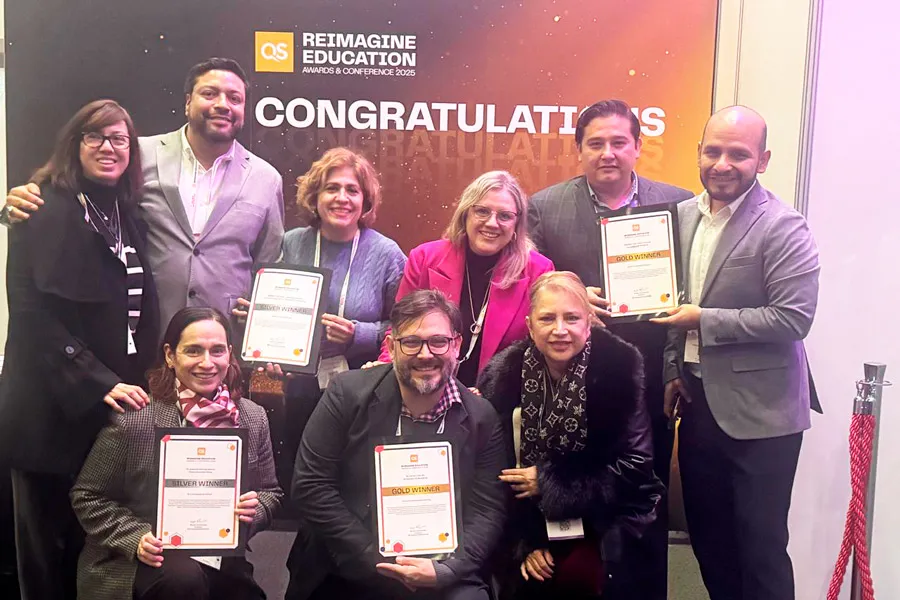
Projects developed at Tecnológico de Monterrey have taken two gold medals and two silver medals (one of which was a Latin American award) at the QS Reimagine Education Awards 2025, an international competition known as the education “Oscars”.
“This tells us that we are on the right track to prepare the educators of the future with ethical, digital, and global tools,” said Leonardo Glasserman, a professor at the Tec’s Institute for the Future of Education(IFE) and one of the international gold medal winners.
The winning projects integrate virtual reality, artificial intelligence, immersive methods, biometrics, and professional assessment models designed to respond to real-world challenges.
Teams from the School of Engineering and Sciences, IFE, Educational Innovation and Digital Learning, the School of Business, and EGADE Business School won the awards with initiatives that, together, chart new paths for applied education.
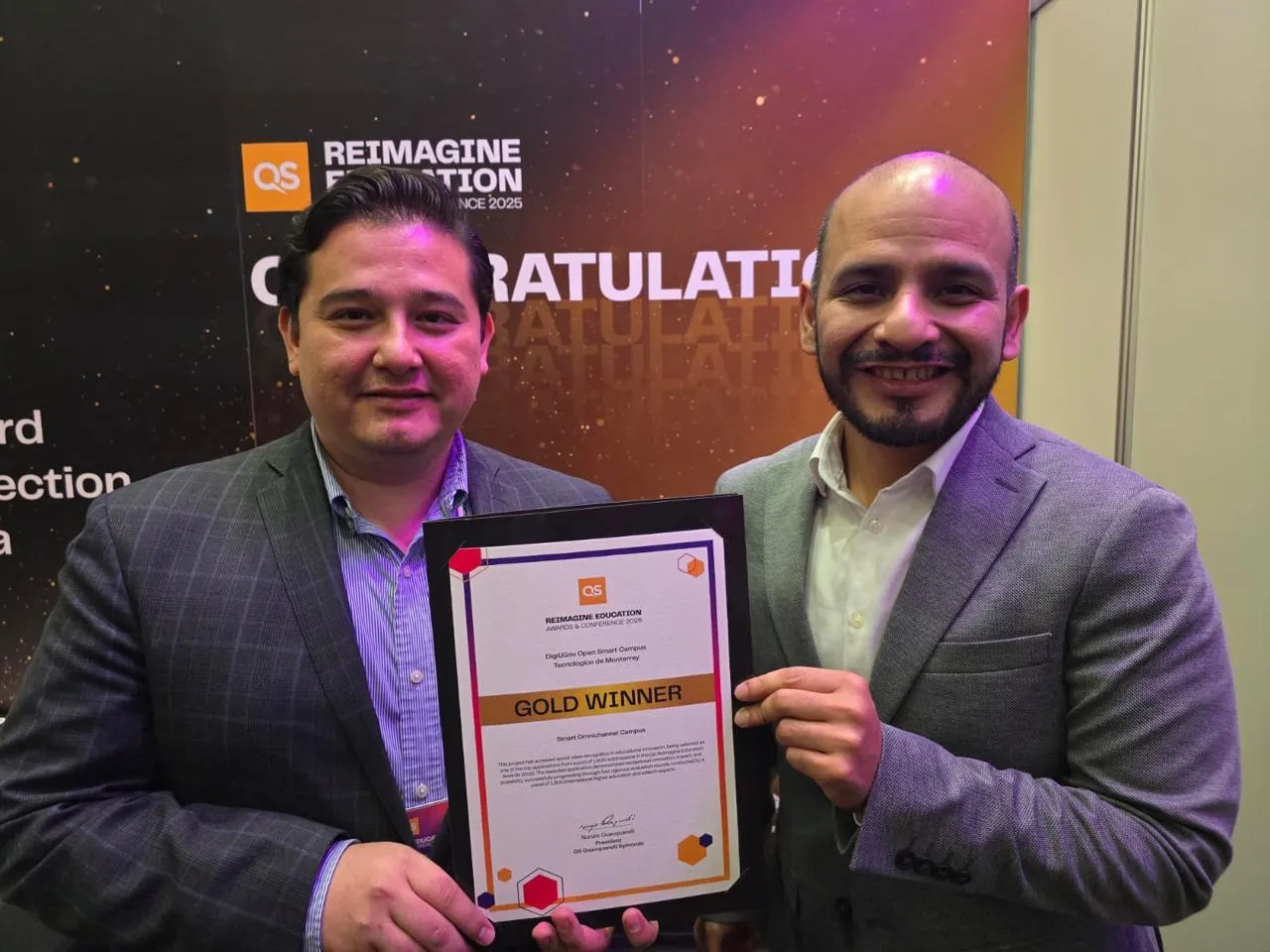
DigiUGov, a smart campus for teachers of the future (Gold)
DigiUGov Open Smart Campus for Future Educators received a Gold Award for its teacher training ecosystem that integrates generative artificial intelligence, multilingual avatars, 360-degree elements, omnichannel tools, and an accessibility approach.
The project was led by IFE researcher Leonardo Glasserman, who emphasizes its inclusive approach.
“It’s an open campus that seeks to bridge gaps and strengthen digital skills and ethical leadership,” he said.
The project makes use of generative AI tools that enable teachers to interact with multilingual avatars, review materials in different formats, and use low-data resources in regions with limited infrastructure.
Project co-leader Jhonattan Miranda commented that it has been implemented internationally.
“DigiUGov has been implemented in seven countries with over a thousand participants. In hybrid mode, we have had retention rates of up to 98% and satisfaction levels of over 90%.”
Miranda commented that the model makes it possible for people undergoing teacher training to have experiences similar to those of a smart campus without depending on its local infrastructure.
Edgar Omar López and Marie Schneider, who are members of the development team, also participated in the project.
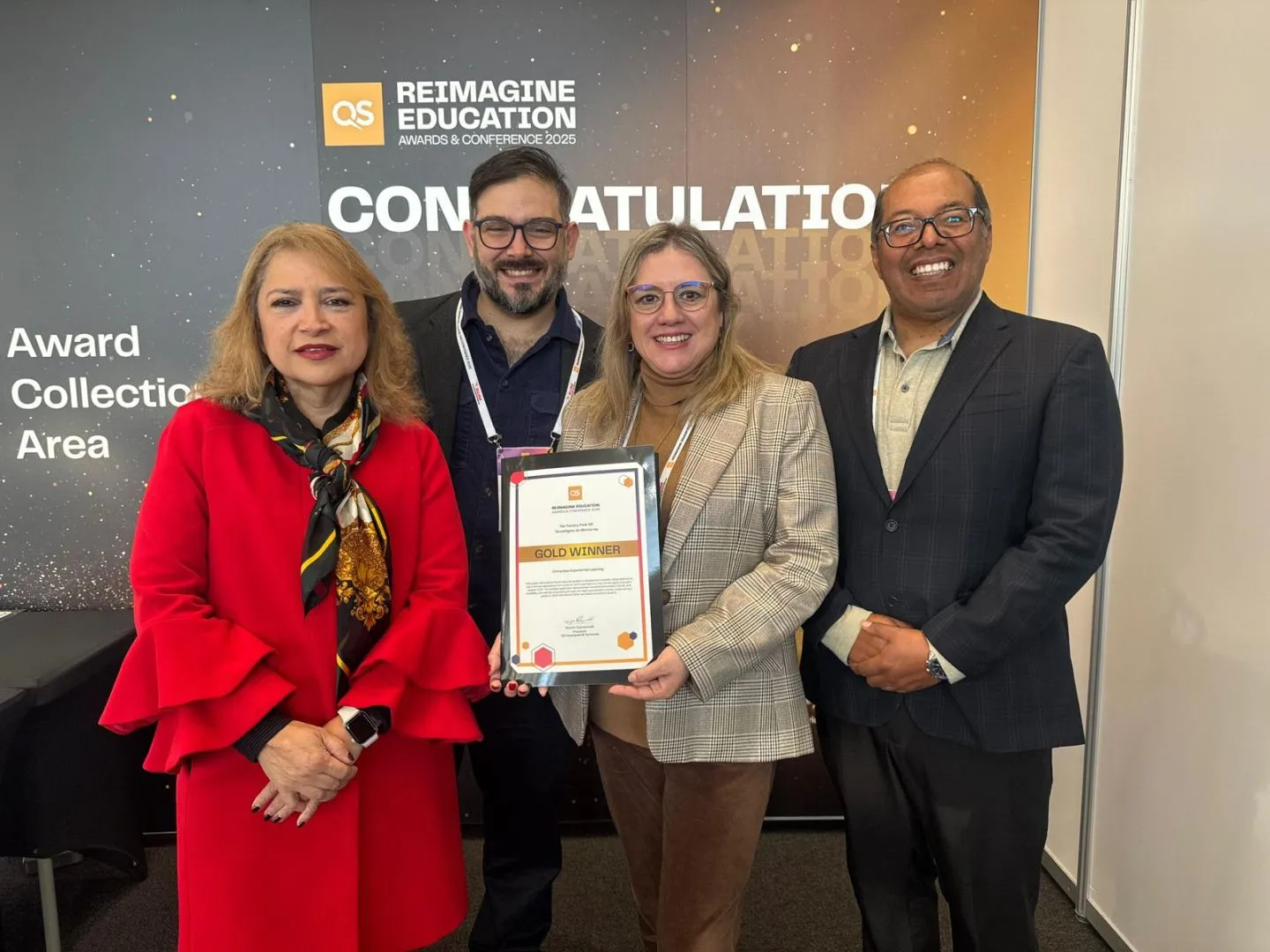
Tec Factory Park: An industrial plant inside the classroom (Gold)
The second gold medal went to Tec Factory Park: Enhancing Industrial Engineering Skills through Immersive Learning with a learning model based on virtual reality and the recreation of industrial scenarios so that students can experience real decision-making processes.
“Tec Factory Park is an immersive virtual reality platform that guides students through the consulting projects they are assigned to as junior consultants in which they face scenarios with data that change according to the problem,” explained Miguel Rocha, a professor from the Querétaro Campus.
In these simulations, students tour plants, analyze processes, interpret information, and evaluate impacts that respond positively or negatively to their decisions.
The project includes a statistics simulator that modifies variables according to real-world patterns in addition to a dashboard that enables teachers to monitor performance and configure new scenarios.
“All students receive different data sets, which makes it impossible for them to work with other people’s answers and forces them to interpret their own cases,” he commented.
Rocha commented that pilot tests have been conducted on four Tec campuses so far, and the team made up of Maribell Reyes, Patricia Aldape, Ingrid Benavides, Ana Gabriela Rodríguez, Mauricio Martínez, Ma. del Carmen Temblador, Jorge Mosqueda, Carmen Uresti, Paulo Mendoza, and Daniel González is getting ready for national expansion.
“The next step is to roll it out nationwide, as well as uploading it to computers and tablets to make it accessible outside the virtual reality lab.”
The project also explores new lines of work: “We want to develop modules concerned with supply chains. The idea is to expand towards complex processes that are indispensable in today’s industry.”
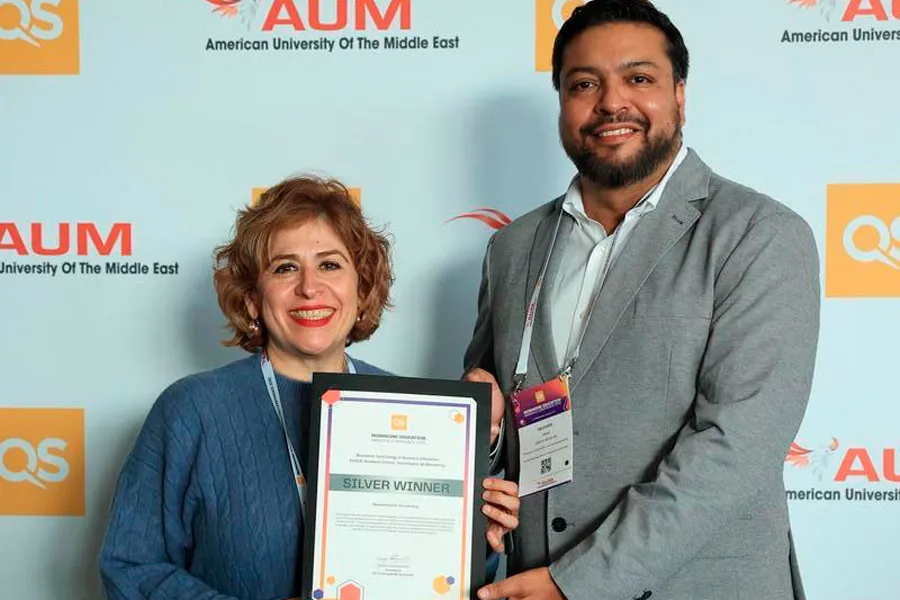
Visualizing Invisible Aspects of Learning: Measuring emotions to understand how we learn (Silver)
The project Biometric Technology in Business Education: Visualizing Invisible Aspects of Learning by EGADE Business School won a silver medal.
This project uses biometrics and artificial intelligence to measure emotions and provide feedback on leadership, communication, and handling complex situations.
The development was spearheaded by professors Isaac Lemus, Jairo Orozco, and Jorge Velarde in collaboration with Eloísa Pérez and Omar Velasco from EGADE’s Educational Innovation Department.
Isaac Lemus explained that this tool makes elements of emotional learning visible that are normally left out of the classroom.
“It brings together two worlds that rarely communicate: what someone says they feel and what their body experiences.”
Students participate in presentations, conflict management, project defense, or simulations for executives. During these experiences, sensors record brain waves, heart rate, perspiration, facial expressions, and voice.
“When they are questioned about details or numbers, the emotional level skyrockets more than in conflict or negotiation exercises,” Lemus explained.
AI processes the data and generates a customized report that identifies moments of stress, emotional regulation, or disconnection in conjunction with performance-improvement techniques.
This project analyzes and refines biometric information. The next phases include new measurements, inclusion in final graduate courses and international collaboration.
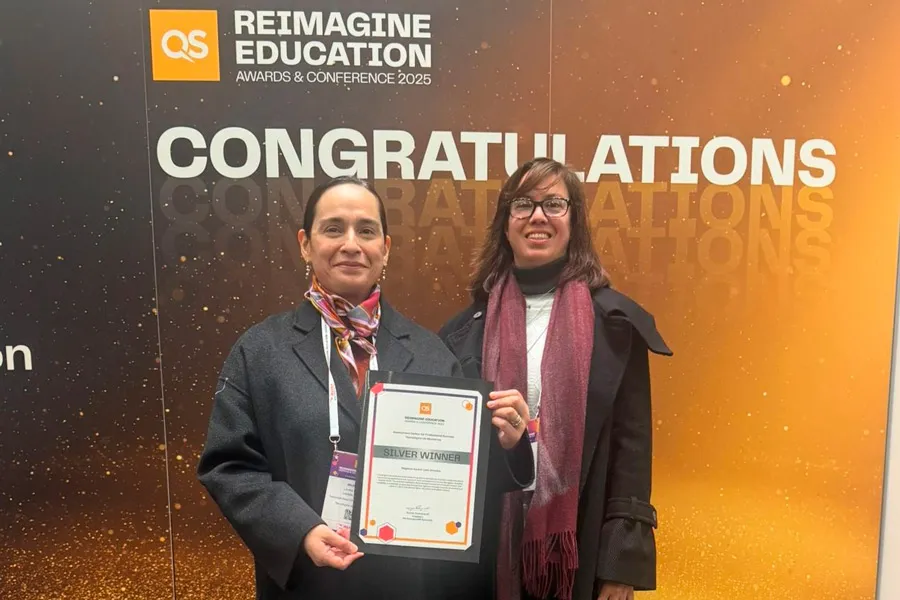
Assessment Center for Professional Success: Bringing real recruitment into the classroom (Silver, Latin-America region)
The Assessment Center for Professional Success, awarded a silver medal in the Latin American region, promotes a new model of professional assessment within Tec de Monterrey’s School of Business.
This initiative, led by Marta Moreno, Laura Zapata, Jorge Ordoñez, and Sergio Sánchez, transforms the way students demonstrate their competencies in real-world job market scenarios.
Professor Laura Zapata explains that this model was created to break with traditional university assessment formats.
“We wanted them to demonstrate that they have the ability to solve a real case, feel comfortable with what they have learned, and respond to the pressure of a professional process.”
The program places students in front of business executives to lead sessions based on real-world cases. They analyze skills such as performance, communication, decision-making, and disciplinary competencies, turning the Assessment into a space for direct feedback with potential employers.
“It’s about bringing the professional world into the classroom with immediate oral and written feedback so they can identify areas for improvement,” added Zapata.
Marta Moreno is of the opinion that the project not only strengthens interaction with companies but also evolves at the same pace as technology.
“We are updating the Assessment to add an AI avatar. We’re not going to eliminate interaction with executives, but we want students to get some practice in beforehand and arrive better prepared.”
This update will broaden the model’s scope and facilitate the participation of external employers.
“We want national and international directors to be able to carry out assessments without physically being on campus,” Moreno said.
The Tec: Making an impact beyond the classroom
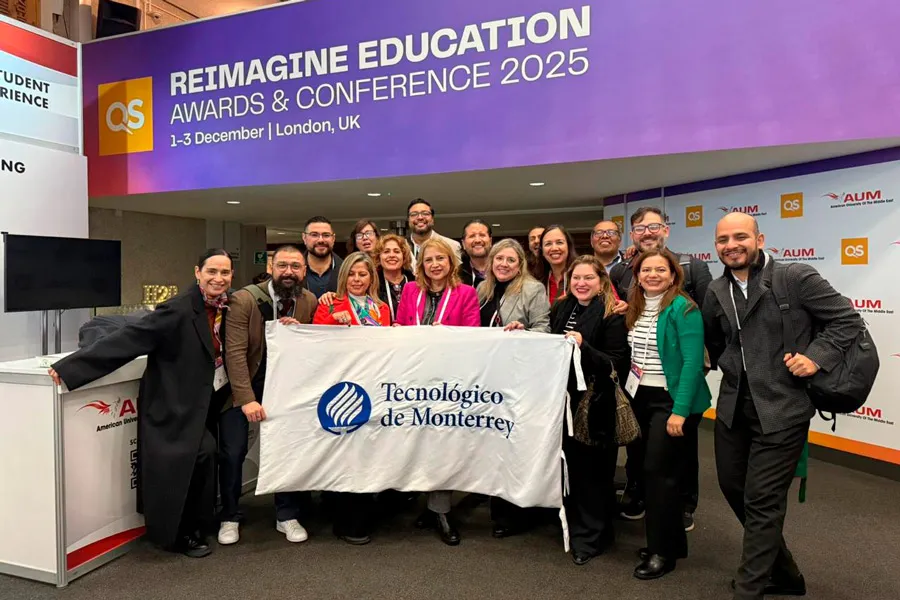
Approximately seven hundred people from around eighty countries participated in the QS Reimagine Education Awards 2025 gala. This award is divided into eighteen categories and assesses programs, technology, and pedagogical approaches that transform education.
In 2025, four of the thirteen Tec projects in the finals won medals.
The Tec Factory Park leaders agree that the gold medal award represents a profound validation of academic and institutional work.
According to Miguel Rocha, this recognition demonstrates that the Tec is developing educational solutions with the true capacity to transform engineering education.
At the IFE, DigiUGov leaders believe that the medal symbolizes a collective achievement that puts the Tec on the international map of educational innovation.
“DigiUGov is a project that was created to bridge gaps; receiving a gold award today means that we can bring this vision to more countries,” said Jhonattan Miranda.
In the case of the Assessment Center and the biometric technology project, the teams see the silver medal as a distinction that reaffirms the Tec’s commitment to comprehensive education.
“For us, it means that this model works, that it connects students with the professional world and that it contributes something valuable to their development,” added Laura Zapata.
“This award confirms that we are pioneering a much-needed line of innovation that enables us to see things that can’t be seen that will help shape more conscious leaders,” concluded Marta Moreno.
YOU MAY ALSO BE INTERESTED IN:
Seleccionar notas relacionadas automáticamente
1
Category:
Related stories