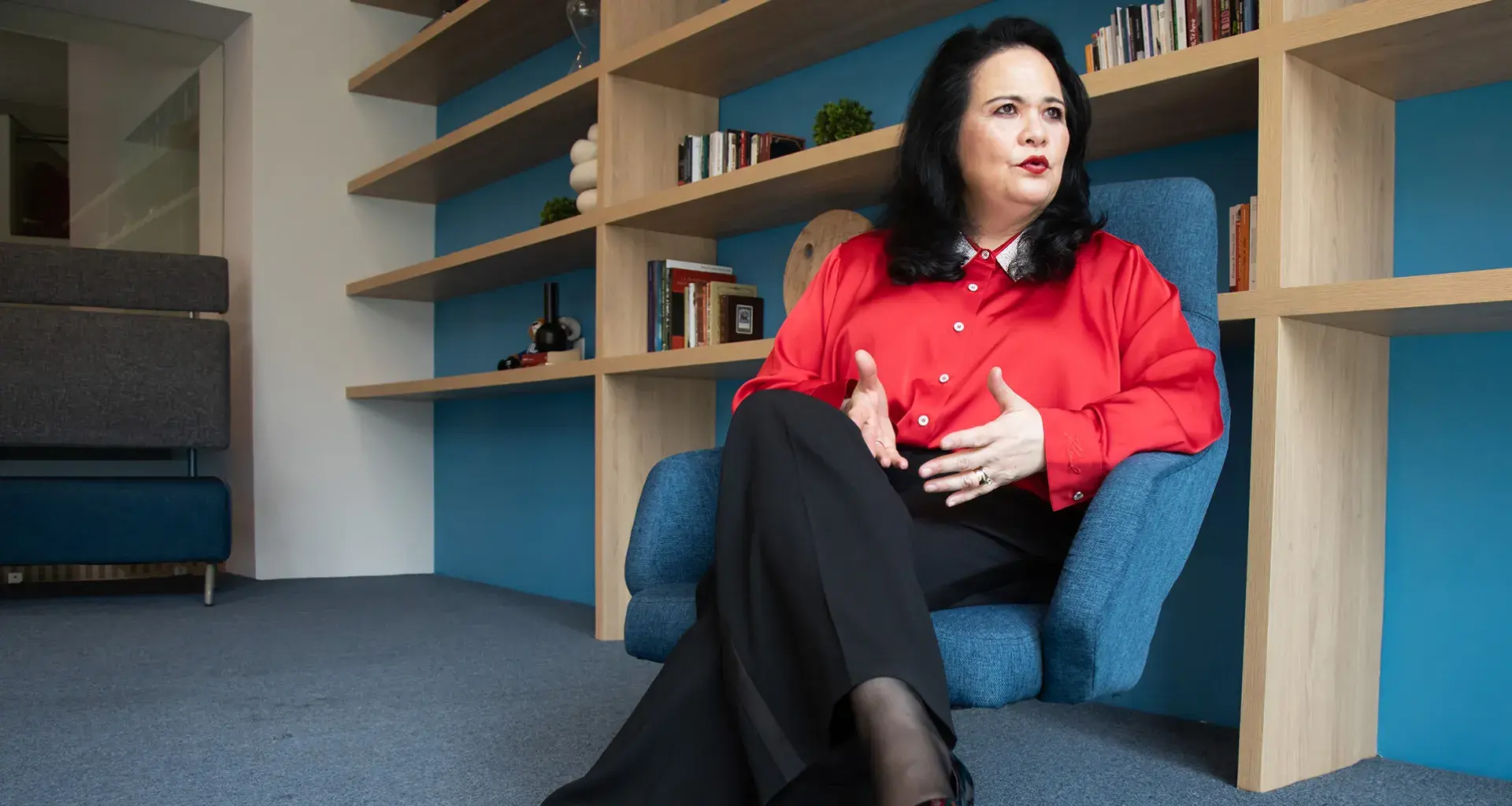

This doctor, who is a specialist in mental health and eating disorders, has received the 2026 Tec Graduate Lifetime Achievement Award from Tec de Monterrey.
When she was six years old, Eva María Trujillo said she wanted to be a pediatrician. Her mother used to talk about it at home, and her father believed that the dream was possible. Over time, that decision led to a journey dedicated to mental health and the treatment of eating disorders.
Now, as she received the 2026 Tec Graduate Lifetime Achievement Award from Tec de Monterrey, she reflected on that starting point. From the girl who first announced her calling to the specialist now leading a hospital center and chairing international associations, one constant thread runs through: training to serve others.
“My calling began long before I earned my degrees,” she said in her speech upon receiving an award from her alma mater for the social impact she has had on the community.
That conviction materialized at the Tec, where she attended high school, earned her medical degree, and completed her specialization in pediatrics. It was there she learned that knowledge should be given back to the community, she recalls. “When the goal is to serve, the way always opens up.”
Based on this, she focused her career on research, clinical practice, and participation in organizations dedicated to treating eating disorders.

Trujillo completed a fellowship in adolescent and young adult medicine at Boston Children’s Hospital at Harvard University, thereby expanding her clinical focus to what she considers a crucial stage of development.
She later earned a master’s degree in Educational Technology and is currently pursuing a Ph.D. in Biomedicine and Health Sciences at the European University of Madrid.
It was from this combination of education, vocation, and practice that the project Comenzar de Nuevo (Starting Over) emerged, which cares for patients, trains professionals, and participates in international studies.
“When the goal is to serve, the way always opens up”.
Training in the spirit of service
Eva María Trujillo describes herself as “all Tec.” “The Tec has not only educated me academically; it has shaped me as a person”.
That training shaped the way she practiced medicine, allowing her to bring what she had learned in the classroom back to the community.
Over time, her work expanded beyond the local community. Trujillo participated in international networks focused on eating disorders and held positions in organizations that bring together researchers and clinical professionals from various countries.
She served as President of the Academy of Eating Disorders and is currently President of the International Association of Eating Disorders Professionals.
“I’m the first female international president they’ve ever had; they’ve always had male presidents from the United States”, she said in an interview with CONECTA, adding:
“It’s a source of pride, an honor, and at the same time a great responsibility”.
From these platforms, she has championed evidence-based training and knowledge exchange between countries.
According to her, these positions require acting in a way that is “highly responsible, ethical, and deeply grounded in human values”.
Dealing with eating disorders
After graduating as a pediatrician, she specialized in adolescent medicine. During that period, she began treating cases of eating disorders more frequently. “The more I delved into the subject, the more I fell in love with it”.
She realized that university education in this field was limited. In many medical programs, students receive very little training on these conditions. As well as this lack of awareness, the constant focus on diets and weight concerns makes early detection difficult, she said.
“What is considered a treatment for obesity is, in fact, a symptom of an eating disorder”, she said.
Extreme calorie restriction or excessive exercise may be seen as a form of self-discipline, but they are actually warning signs according to the doctor.
In response to the notion that these disorders are permanent, she insisted: “Eating disorders can be treated, and we must spread that message”.

Specialized center for comprehensive care
Her clinical experience led her to conclude that individual consultations were not enough. It was necessary to develop a comprehensive model that included medical, nutritional, and psychological care, as well as research and prevention.
In 1999, Comenzar de Nuevo was born. When it opened its doors, there were no other centers in the region specializing in eating disorders.
“There weren’t any models, or structure. Only the deep conviction that those who were suffering deserved to be treated with dignity, professionalism, and humanity”.
The project started with the idea of offering a scientifically based treatment supported by the family.
"True excellence lies in using who we are and what we know to alleviate the suffering of others".
Her methodinvolves several stages: first, medical and nutritional recovery; then, evidence-based therapeutic work; and finally, reintegration into daily life.
Trujillo said these disorders affect both cognitive function and bodily systems, so treatment must be comprehensive.
As Co-Founder and Executive Director of Comenzar de Nuevo, she and her team have transformed the lives of more than 15,000 patients and their families. It’s the only center in Latin America that offers comprehensive care for these conditions.
This led her to participate in planning and public policy initiatives. She is a member of the Nuevo León Strategic Planning Board for 2040. What’s more, she has promoted the training of new specialists.
Trujillo mentors healthcare professionals, serves as a clinical professor at Tecnológico de Monterrey’s School of Medicine and Health Sciences, and teaches on the master’s program for Eating Disorders at Adolfo Ibáñez University’s School of Psychology in Chile.

The value of daily impact
According to the academic, interacting with patients and their families is what drives her work. Hearing that someone has decided to move forward, seeing a family manage to recover, or receiving a thank-you note are moments that define her practice.
Hanging in her office is a painting that a patient gave her; she describes it as a tree bursting with color. Prior to treatment, the young woman had painted a gray version. After advancing in the process, she decided to depict it using different colors.
“The treatment had made her see life in those colors.
“Once you realize the impact of that, no degree, no recognition, and no amount of money can compare”.
She uses an analogy to describe the challenge of recovery: returning to the community can be like leaving a rehab facility and getting a job at a bar.
Conversations about diets and the body remain a common topic. Therefore, she highlights the importance of family and support networks as protective factors.
“The most rewarding part is seeing the smiles on those parents’ faces when they tell me their children are getting better”.

Recognition and Purpose
Upon receiving the Tec Graduate Lifetime Achievement Award, she said that this recognition gives her a sense of belonging and responsibility.
She believes that each award represents an additional responsibility toward her patients and the scientific community.
“True excellence lies in using who we are and what we know to alleviate the suffering of others”.
Her awards include being on the Forbes list of the 100 Most Powerful Women in Mexico (2023), the Dr. Carlos Canseco Medal of Merit (2022), and the Mujer Tec Award (2023).
After receiving the award, she thanked her father, who believed in her dream, and also spoke of her husband Alfredo, whom she describes as “my life partner, friend, confidant, and my rock.” She also thanked her children, who have stood by her throughout her career, from night shifts to emergency calls. “If there’s something I’ve done right in life, it’s being their mother”.
The girl who wanted to be a pediatrician found herself in a field where pain can go unnoticed, and stigma is commonplace. Since then, she has worked tirelessly to place mental health at the center of academic and public discourse, convinced that knowledge, when shared, can change the course of a life.
*With information from Susan Iraís
YOU’LL ALSO WANT TO READ:
Seleccionar notas relacionadas automáticamente
1
Category:
Related stories